Category: Uncategorized

  • Man Overboard System vs. Man Overboard Wristband: Which Is Better for Your Crew?

    Man Overboard System vs. Man Overboard Wristband: Which Is Better for Your Crew?

    decision-stage comparison
    scope: fixed man overboard systems, bridge alarms, deck cameras, LiDAR, AIS/GNSS beacons, wearable wristbands, autonomous man overboard rescue
    primary criteria: detection speed, false-alarm control, location accuracy, crew compliance, bridge integration, rescue execution, night capability, operating continuity

    Executive comparison

    A conventional man overboard system and a man overboard wristband solve different parts of the same operational problem.

    Fixed systems monitor the vessel perimeter. Typical configurations include deck cameras, thermal cameras, LiDAR, radar, bridge alarms, video analytics, and manual recovery procedures. Their primary strength: broad-area monitoring without requiring every person on board to wear a device.

    Wearable systems monitor the individual. A wristband can combine fall motion, altitude change, water immersion, and GPS positioning. Its primary strength: direct event evidence and continuous location data for equipped crew members.

    For most commercial vessels, the highest-value architecture is not a replacement model. It is a layered model:

    fixed perimeter awareness + wearable crew detection + bridge visibility + automated flotation delivery

    The CruiseShipWristband system completes the response chain through two integrated applications:

    fall detection → GPS transmission → autonomous DJI launch → inflatable life vest delivery → live tracking

    1. Conventional man overboard system: operating model

    A classic MOB response stack generally includes:

    • Deck surveillance cameras
    • Thermal or infrared cameras
    • Perimeter LiDAR or radar
    • Bridge alarm panels
    • CCTV review
    • Manual MOB button activation
    • AIS or GNSS locating equipment
    • Rescue boat or recovery-team deployment
    • Crew procedures and emergency drills

    The system observes the ship and surrounding water. A fall may be detected through a person crossing a monitored boundary, an object entering a scan zone, visual analytics, or manual observation.

    Fixed monitoring remains valuable for:

    • Passenger areas
    • Open decks
    • Unrestricted perimeter coverage
    • Unidentified persons overboard
    • Situations involving non-equipped personnel
    • Video confirmation
    • Post-event investigation
    • Existing bridge and security workflows

    Specialized equipment can reduce the limitations of basic CCTV. For example, SICK describes 3D LiDAR systems designed to detect objects crossing defined shipboard scan areas while filtering conditions such as spray, waves, and birds. Their man overboard detection overview identifies real-time notification and false-alarm reduction as central system requirements.

    The limitation: fixed systems interpret an external environment. Glare, rain, sea spray, wakes, darkness, camera obstruction, vessel movement, and sensor calibration remain relevant operating conditions.

    2. Man overboard wristband: operating model

    A man overboard wristband places detection capability on the person at risk.

    The Location Provider app uses three primary signal categories:

    • Accelerometer: sudden movement and fall-pattern detection
    • Barometric sensor: rapid altitude change associated with movement from deck level toward the water
    • Water immersion detection: confirmation of water contact
    • GPS positioning: continuous location transmission after activation

    The result: direct wearer data rather than visual interpretation of a distant waterline.

    CruiseShipWristband specifies sub-2-second detection through multi-sensor fusion. The detection model does not depend on one signal alone. A fall pattern, altitude change, and immersion event provide combined evidence intended to reduce false positives associated with simple link-loss, motion-only, or splash-only triggers.

    The wristband model is most applicable to:

    • Deck crew
    • Engineering personnel
    • Maintenance teams
    • Offshore workers
    • Commercial shipping crews
    • Night-watch personnel
    • Transfer and boarding teams
    • Personnel assigned to exposed or restricted-access areas

    The operating dependency: correct wear, active pairing, battery availability, and deployment compliance.

    3. Detection speed and response time

    Detection speed is only the first metric. The operational sequence also includes confirmation, location transfer, response initiation, flotation delivery, and recovery.

    Evaluation factor Conventional MOB system Man overboard wristband
    Detection source Ship perimeter or visual scene Direct wearer data
    Typical inputs Camera, thermal, LiDAR, radar, manual alarm Accelerometer, barometric sensor, immersion detection, GPS
    Coverage Monitored vessel areas Equipped personnel
    Initial location Estimated fall zone or marked position Continuous GPS coordinates
    Bridge notification Alarm panel, CCTV, integrated dashboard Alert broadcast to Drone Controller and bridge dashboard
    False-alarm risk Spray, waves, glare, birds, shadows, debris Single-sensor triggers, pairing loss, battery failure, incorrect wear
    Response initiation Manual or automated, depending on installation Autonomous Drone Controller workflow
    Flotation delivery Crew, lifebuoy, rescue boat, or other equipment DJI drone with inflatable life vest
    Night capability Visible, infrared, or thermal camera configuration Sensor-based detection plus drone thermal-imaging options
    Human intervention Frequently required for confirmation or deployment Zero human intervention from detection to vest deployment; manual override available

    The CruiseShipWristband target: under two seconds from fall event to detection. The rescue sequence then transfers the event and GPS position to the Drone Controller app.

    4. False alarm fatigue

    False alarm fatigue is an operational risk, not a minor usability issue.

    Repeated nuisance alarms can produce:

    • Delayed acknowledgment
    • Reduced bridge trust
    • Alarm masking
    • Manual bypass behavior
    • Increased workload for safety teams
    • Lower confidence in automated maritime safety equipment

    Conventional systems address false alarms through:

    • Multi-camera correlation
    • AI classification
    • Thermal confirmation
    • LiDAR filtering
    • Defined scan zones
    • Human bridge review
    • Alarm escalation rules

    Wearable systems require a different control strategy. A simple water switch may activate from splash exposure. A radio tether may alarm when the wearer moves out of range while still aboard. A single accelerometer trigger may classify routine work movement as a fall.

    The CruiseShipWristband approach uses multi-sensor fusion. The Location Provider combines acceleration, barometric change, and water immersion evidence before issuing the MOB alert. The objective: elimination of false-positive triggers associated with isolated sensor events.

    No automated detection architecture removes the need for testing. Required operational controls include:

    • Device registration
    • Wearer assignment
    • Pre-shift activation checks
    • Battery-status monitoring
    • Controlled immersion and fall testing
    • Bridge alarm verification
    • False-alarm reporting
    • Periodic crew drills

    5. Crew wearing compliance, comfort, and continuity

    A wristband-based man overboard detection system is effective only when the assigned person wears and activates the device correctly.

    Procurement and safety teams should evaluate:

    • Wristband weight
    • Glove compatibility
    • Water resistance
    • Interference with tools and PPE
    • Attachment security
    • Charging procedures
    • Shift handover requirements
    • Activation-state visibility
    • Battery duration
    • Comfort during extended work periods

    The CruiseShipWristband Location Provider includes low-power operation for all-day battery performance. The design objective: continuous background monitoring during extended vessel operations and multi-day voyages.

    Fixed systems have an operational advantage in this category. Cameras and perimeter sensors do not require individual compliance. Wearables have an operational advantage in another category: direct identification of the monitored person and continuous GPS position.

    A practical deployment model can assign wristbands to personnel with the highest exposure risk while retaining fixed cameras and bridge systems for broader vessel awareness.

    6. Integration with bridge and alarm systems

    Integration determines whether a man overboard system functions as operational infrastructure or remains an isolated device.

    Relevant integration points:

    • Bridge alerting
    • Security dashboards
    • GPS and electronic chart displays
    • CCTV review
    • Existing emergency procedures
    • Manual MOB controls
    • Drone status
    • Live video feed
    • Location history
    • Event logging
    • Manual override

    The CruiseShipWristband platform separates responsibilities across two companion Android applications.

    Location Provider

    wristband-side functions:

    • Sub-2-second fall detection
    • Accelerometer monitoring
    • Barometric altitude monitoring
    • Water immersion confirmation
    • Continuous GPS positioning
    • Immediate alert broadcast
    • Low-power background operation

    The Location Provider app provides the event and location layer.

    Drone Controller

    ship-side functions:

    • MOB alert reception
    • Autonomous DJI launch
    • GPS navigation
    • Live camera feed
    • Inflatable life vest deployment
    • Bridge status display
    • Manual security-team override

    The Drone Controller app provides the response and flotation-delivery layer.

    The platform is not positioned as a replacement for bridge watchkeeping, rescue procedures, or vessel-specific emergency management. It is an automation layer between detection and immediate flotation.

    7. Location accuracy and rescue execution

    The primary operational difference between an alarm and a rescue system: actionable location.

    A fixed camera may identify the approximate point of departure. A bridge operator may mark the vessel position manually. An AIS or GNSS beacon may transmit a position after activation. A wristband with continuous GPS can provide the wearer’s position directly to the paired rescue workflow.

    Wearable wristband using fall, altitude, immersion, and GPS data during an autonomous maritime rescue response

    The CruiseShipWristband rescue sequence:

    1. Detection: Location Provider identifies the fall and immersion event.
    2. Position transfer: GPS coordinates transmit to Drone Controller.
    3. Launch: DJI drone launches autonomously.
    4. Navigation: Drone travels to the transmitted coordinates.
    5. Deployment: Inflatable life vest is released.
    6. Tracking: Location Provider continues updating position.
    7. Bridge visibility: Live video and status data remain available.

    The principal operational benefit: flotation delivery begins without waiting for a person to observe the event, confirm the alarm, retrieve equipment, and manually launch the first response.

    8. Day and night rescue capability

    Environmental conditions affect fixed detection systems most directly.

    Common night and weather constraints:

    • Low visible-light contrast
    • Rain
    • Spray
    • Reflections
    • Rough sea state
    • Thermal clutter
    • Camera contamination
    • Vessel lighting changes

    Thermal cameras and infrared systems can improve fixed-system performance. The CruiseShipWristband architecture adds thermal-imaging options to the drone response layer, with live camera visibility for the bridge.

    Autonomous drone delivering an inflatable life vest to an exact GPS location during a nighttime man overboard response

    This creates a complementary division:

    • Fixed systems: vessel and waterline observation
    • Wristband: wearer event and GPS data
    • Drone: mobile visual confirmation and flotation delivery
    • Bridge: operational oversight, escalation, and manual override

    9. Standards and system selection

    The ITU-R M.2285 report identifies two general MOB functions:

    • Immediate notification to the parent vessel
    • A means of locating the person overboard

    It also notes that no single MOB technology is suitable for every vessel, operating environment, or user profile.

    Operators evaluating a man overboard detection system should document:

    • Persons requiring coverage
    • Perimeter areas requiring monitoring
    • Required alert time
    • Location accuracy
    • Battery and charging procedures
    • False-alarm controls
    • Bridge-system integration
    • Night and weather performance
    • Manual override
    • Rescue-equipment deployment
    • Test and drill requirements
    • Regulatory and operational approvals

    For the distinction between person-focused sensing and vessel-focused observation, the related comparison, Wristband Sensors vs. Deck Cameras, provides the sensor-to-camera perspective. This article addresses the broader system-to-system decision.

    Final evaluation

    Conventional MOB system: broad coverage, established bridge integration, visual confirmation, fixed installation, no individual wearing requirement.

    Man overboard wristband: direct wearer detection, sub-2-second multi-sensor event processing, continuous GPS, individual identification, low-power operation, targeted crew coverage.

    CruiseShipWristband autonomous rescue system: wristband detection plus GPS tracking plus autonomous drone launch plus inflatable life vest delivery plus live bridge visibility.

    The strongest architecture for crew protection is not fixed system versus wristband as an exclusive choice.

    recommended safety stack:
    perimeter monitoring → wearable detection → multi-sensor confirmation → exact GPS location → autonomous flotation delivery → bridge oversight

    Integrated man overboard rescue pipeline showing wristband detection, autonomous drone launch, vest deployment, thermal tracking, and bridge visibility

  • Man Overboard System vs. Man Overboard Wristband: Which Is Better for Your Crew?

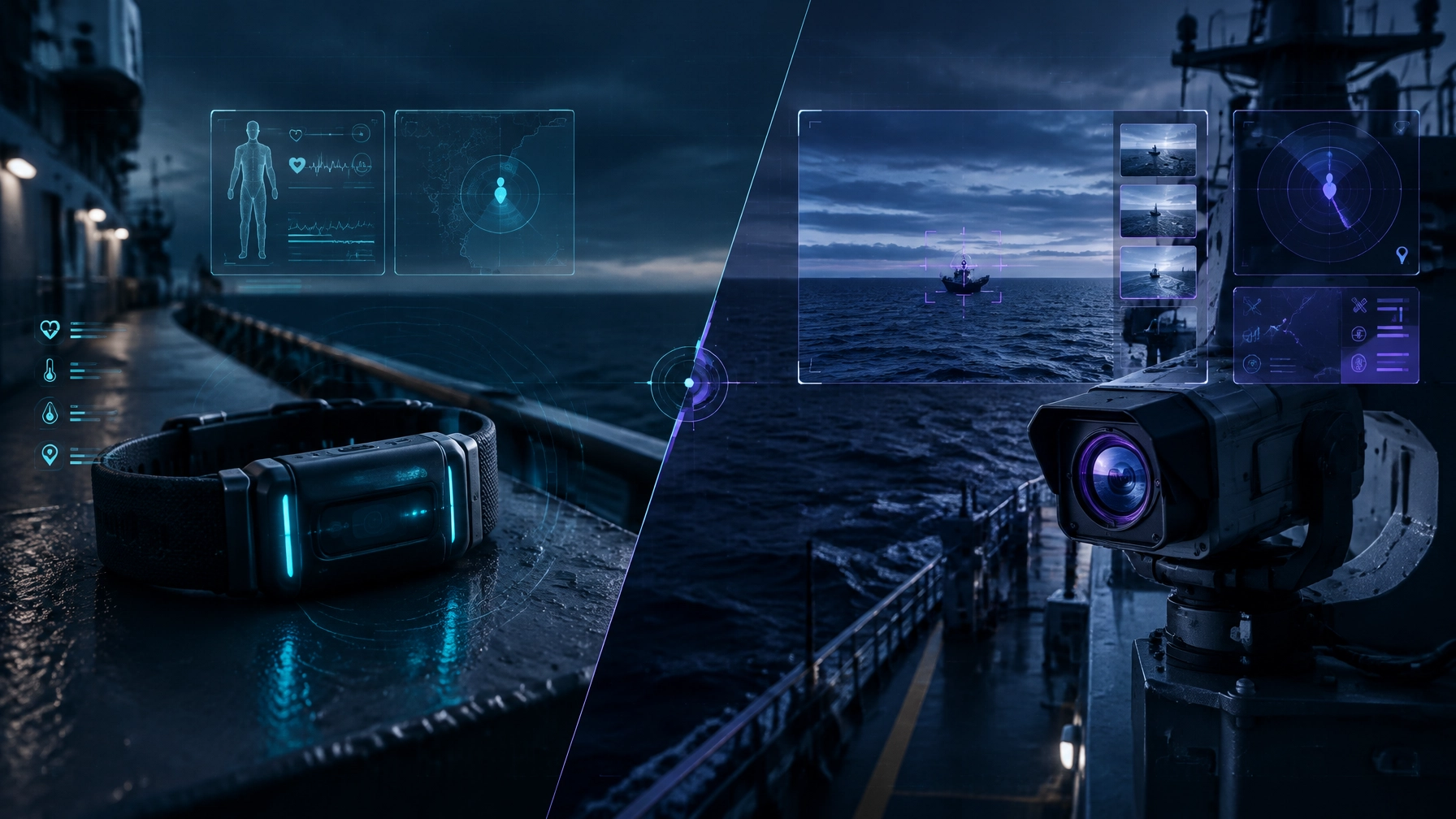
    Maritime safety comparison showing a wearable man overboard wristband and a ship-mounted monitoring camera with digital tracking overlays

    decision-stage comparison
    scope: fixed man overboard systems, bridge alarms, deck cameras, LiDAR, AIS/GNSS beacons, wearable wristbands, autonomous man overboard rescue
    primary criteria: detection speed, false-alarm control, location accuracy, crew compliance, bridge integration, rescue execution, night capability, operating continuity

    Executive comparison

    A conventional man overboard system and a man overboard wristband solve different parts of the same operational problem.

    Fixed systems monitor the vessel perimeter. Typical configurations include deck cameras, thermal cameras, LiDAR, radar, bridge alarms, video analytics, and manual recovery procedures. Their primary strength: broad-area monitoring without requiring every person on board to wear a device.

    Wearable systems monitor the individual. A wristband can combine fall motion, altitude change, water immersion, and GPS positioning. Its primary strength: direct event evidence and continuous location data for equipped crew members.

    For most commercial vessels, the highest-value architecture is not a replacement model. It is a layered model:

    fixed perimeter awareness + wearable crew detection + bridge visibility + automated flotation delivery

    The CruiseShipWristband system completes the response chain through two integrated applications:

    fall detection → GPS transmission → autonomous DJI launch → inflatable life vest delivery → live tracking

    1. Conventional man overboard system: operating model

    A classic MOB response stack generally includes:

    • Deck surveillance cameras
    • Thermal or infrared cameras
    • Perimeter LiDAR or radar
    • Bridge alarm panels
    • CCTV review
    • Manual MOB button activation
    • AIS or GNSS locating equipment
    • Rescue boat or recovery-team deployment
    • Crew procedures and emergency drills

    The system observes the ship and surrounding water. A fall may be detected through a person crossing a monitored boundary, an object entering a scan zone, visual analytics, or manual observation.

    Fixed monitoring remains valuable for:

    • Passenger areas
    • Open decks
    • Unrestricted perimeter coverage
    • Unidentified persons overboard
    • Situations involving non-equipped personnel
    • Video confirmation
    • Post-event investigation
    • Existing bridge and security workflows

    Specialized equipment can reduce the limitations of basic CCTV. For example, SICK describes 3D LiDAR systems designed to detect objects crossing defined shipboard scan areas while filtering conditions such as spray, waves, and birds. Their man overboard detection overview identifies real-time notification and false-alarm reduction as central system requirements.

    The limitation: fixed systems interpret an external environment. Glare, rain, sea spray, wakes, darkness, camera obstruction, vessel movement, and sensor calibration remain relevant operating conditions.

    2. Man overboard wristband: operating model

    A man overboard wristband places detection capability on the person at risk.

    The Location Provider app uses three primary signal categories:

    • Accelerometer: sudden movement and fall-pattern detection
    • Barometric sensor: rapid altitude change associated with movement from deck level toward the water
    • Water immersion detection: confirmation of water contact
    • GPS positioning: continuous location transmission after activation

    The result: direct wearer data rather than visual interpretation of a distant waterline.

    CruiseShipWristband specifies sub-2-second detection through multi-sensor fusion. The detection model does not depend on one signal alone. A fall pattern, altitude change, and immersion event provide combined evidence intended to reduce false positives associated with simple link-loss, motion-only, or splash-only triggers.

    The wristband model is most applicable to:

    • Deck crew
    • Engineering personnel
    • Maintenance teams
    • Offshore workers
    • Commercial shipping crews
    • Night-watch personnel
    • Transfer and boarding teams
    • Personnel assigned to exposed or restricted-access areas

    The operating dependency: correct wear, active pairing, battery availability, and deployment compliance.

    3. Detection speed and response time

    Detection speed is only the first metric. The operational sequence also includes confirmation, location transfer, response initiation, flotation delivery, and recovery.

    Evaluation factor Conventional MOB system Man overboard wristband
    Detection source Ship perimeter or visual scene Direct wearer data
    Typical inputs Camera, thermal, LiDAR, radar, manual alarm Accelerometer, barometric sensor, immersion detection, GPS
    Coverage Monitored vessel areas Equipped personnel
    Initial location Estimated fall zone or marked position Continuous GPS coordinates
    Bridge notification Alarm panel, CCTV, integrated dashboard Alert broadcast to Drone Controller and bridge dashboard
    False-alarm risk Spray, waves, glare, birds, shadows, debris Single-sensor triggers, pairing loss, battery failure, incorrect wear
    Response initiation Manual or automated, depending on installation Autonomous Drone Controller workflow
    Flotation delivery Crew, lifebuoy, rescue boat, or other equipment DJI drone with inflatable life vest
    Night capability Visible, infrared, or thermal camera configuration Sensor-based detection plus drone thermal-imaging options
    Human intervention Frequently required for confirmation or deployment Zero human intervention from detection to vest deployment; manual override available

    The CruiseShipWristband target: under two seconds from fall event to detection. The rescue sequence then transfers the event and GPS position to the Drone Controller app.

    4. False alarm fatigue

    False alarm fatigue is an operational risk, not a minor usability issue.

    Repeated nuisance alarms can produce:

    • Delayed acknowledgment
    • Reduced bridge trust
    • Alarm masking
    • Manual bypass behavior
    • Increased workload for safety teams
    • Lower confidence in automated maritime safety equipment

    Conventional systems address false alarms through:

    • Multi-camera correlation
    • AI classification
    • Thermal confirmation
    • LiDAR filtering
    • Defined scan zones
    • Human bridge review
    • Alarm escalation rules

    Wearable systems require a different control strategy. A simple water switch may activate from splash exposure. A radio tether may alarm when the wearer moves out of range while still aboard. A single accelerometer trigger may classify routine work movement as a fall.

    The CruiseShipWristband approach uses multi-sensor fusion. The Location Provider combines acceleration, barometric change, and water immersion evidence before issuing the MOB alert. The objective: elimination of false-positive triggers associated with isolated sensor events.

    No automated detection architecture removes the need for testing. Required operational controls include:

    • Device registration
    • Wearer assignment
    • Pre-shift activation checks
    • Battery-status monitoring
    • Controlled immersion and fall testing
    • Bridge alarm verification
    • False-alarm reporting
    • Periodic crew drills

    5. Crew wearing compliance, comfort, and continuity

    A wristband-based man overboard detection system is effective only when the assigned person wears and activates the device correctly.

    Procurement and safety teams should evaluate:

    • Wristband weight
    • Glove compatibility
    • Water resistance
    • Interference with tools and PPE
    • Attachment security
    • Charging procedures
    • Shift handover requirements
    • Activation-state visibility
    • Battery duration
    • Comfort during extended work periods

    The CruiseShipWristband Location Provider includes low-power operation for all-day battery performance. The design objective: continuous background monitoring during extended vessel operations and multi-day voyages.

    Fixed systems have an operational advantage in this category. Cameras and perimeter sensors do not require individual compliance. Wearables have an operational advantage in another category: direct identification of the monitored person and continuous GPS position.

    A practical deployment model can assign wristbands to personnel with the highest exposure risk while retaining fixed cameras and bridge systems for broader vessel awareness.

    6. Integration with bridge and alarm systems

    Integration determines whether a man overboard system functions as operational infrastructure or remains an isolated device.

    Relevant integration points:

    • Bridge alerting
    • Security dashboards
    • GPS and electronic chart displays
    • CCTV review
    • Existing emergency procedures
    • Manual MOB controls
    • Drone status
    • Live video feed
    • Location history
    • Event logging
    • Manual override

    The CruiseShipWristband platform separates responsibilities across two companion Android applications.

    Location Provider

    wristband-side functions:

    • Sub-2-second fall detection
    • Accelerometer monitoring
    • Barometric altitude monitoring
    • Water immersion confirmation
    • Continuous GPS positioning
    • Immediate alert broadcast
    • Low-power background operation

    The Location Provider app provides the event and location layer.

    Drone Controller

    ship-side functions:

    • MOB alert reception
    • Autonomous DJI launch
    • GPS navigation
    • Live camera feed
    • Inflatable life vest deployment
    • Bridge status display
    • Manual security-team override

    The Drone Controller app provides the response and flotation-delivery layer.

    The platform is not positioned as a replacement for bridge watchkeeping, rescue procedures, or vessel-specific emergency management. It is an automation layer between detection and immediate flotation.

    7. Location accuracy and rescue execution

    The primary operational difference between an alarm and a rescue system: actionable location.

    A fixed camera may identify the approximate point of departure. A bridge operator may mark the vessel position manually. An AIS or GNSS beacon may transmit a position after activation. A wristband with continuous GPS can provide the wearer’s position directly to the paired rescue workflow.

    Wearable wristband using fall, altitude, immersion, and GPS data during an autonomous maritime rescue response

    The CruiseShipWristband rescue sequence:

    1. Detection: Location Provider identifies the fall and immersion event.
    2. Position transfer: GPS coordinates transmit to Drone Controller.
    3. Launch: DJI drone launches autonomously.
    4. Navigation: Drone travels to the transmitted coordinates.
    5. Deployment: Inflatable life vest is released.
    6. Tracking: Location Provider continues updating position.
    7. Bridge visibility: Live video and status data remain available.

    The principal operational benefit: flotation delivery begins without waiting for a person to observe the event, confirm the alarm, retrieve equipment, and manually launch the first response.

    8. Day and night rescue capability

    Environmental conditions affect fixed detection systems most directly.

    Common night and weather constraints:

    • Low visible-light contrast
    • Rain
    • Spray
    • Reflections
    • Rough sea state
    • Thermal clutter
    • Camera contamination
    • Vessel lighting changes

    Thermal cameras and infrared systems can improve fixed-system performance. The CruiseShipWristband architecture adds thermal-imaging options to the drone response layer, with live camera visibility for the bridge.

    Autonomous drone delivering an inflatable life vest to an exact GPS location during a nighttime man overboard response

    This creates a complementary division:

    • Fixed systems: vessel and waterline observation
    • Wristband: wearer event and GPS data
    • Drone: mobile visual confirmation and flotation delivery
    • Bridge: operational oversight, escalation, and manual override

    9. Standards and system selection

    The ITU-R M.2285 report identifies two general MOB functions:

    • Immediate notification to the parent vessel
    • A means of locating the person overboard

    It also notes that no single MOB technology is suitable for every vessel, operating environment, or user profile.

    Operators evaluating a man overboard detection system should document:

    • Persons requiring coverage
    • Perimeter areas requiring monitoring
    • Required alert time
    • Location accuracy
    • Battery and charging procedures
    • False-alarm controls
    • Bridge-system integration
    • Night and weather performance
    • Manual override
    • Rescue-equipment deployment
    • Test and drill requirements
    • Regulatory and operational approvals

    For the distinction between person-focused sensing and vessel-focused observation, the related comparison, Wristband Sensors vs. Deck Cameras, provides the sensor-to-camera perspective. This article addresses the broader system-to-system decision.

    Final evaluation

    Conventional MOB system: broad coverage, established bridge integration, visual confirmation, fixed installation, no individual wearing requirement.

    Man overboard wristband: direct wearer detection, sub-2-second multi-sensor event processing, continuous GPS, individual identification, low-power operation, targeted crew coverage.

    CruiseShipWristband autonomous rescue system: wristband detection plus GPS tracking plus autonomous drone launch plus inflatable life vest delivery plus live bridge visibility.

    The strongest architecture for crew protection is not fixed system versus wristband as an exclusive choice.

    recommended safety stack:
    perimeter monitoring → wearable detection → multi-sensor confirmation → exact GPS location → autonomous flotation delivery → bridge oversight

    Integrated man overboard rescue pipeline showing wristband detection, autonomous drone launch, vest deployment, thermal tracking, and bridge visibility

  • Wristband Sensors vs. Deck Cameras: Which Man Overboard Detection Actually Works?

    Comparison of wristband sensors and deck cameras for man overboard detection

    A man overboard event becomes a rescue operation only when the vessel detects it quickly, identifies the location accurately, and delivers flotation without delay.

    For maritime safety officers, fleet managers, and procurement teams, the critical question is not whether a system uses cameras or sensors. The question is whether it produces a dependable response in real operating conditions.

    Camera-only systems monitor the ship’s surroundings. Wristband systems monitor the person wearing the device. These are fundamentally different detection models.

    For equipped crew and high-risk personnel, a multi-sensor wristband provides a direct, fast, and actionable trigger. CruiseShipWristband extends that trigger into a complete automated pipeline:

    Fall detection → GPS location → Drone launch → Inflatable vest delivery → Live tracking

    The Short Answer

    Deck cameras provide visual coverage. They also face environmental interference from sun glare, wakes, rain, sea spray, heat signatures, darkness, and vessel movement.

    A wristband-based system detects the wearer directly through multiple inputs:

    • Accelerometer movement
    • Barometric altitude change
    • Water immersion
    • Continuous GPS positioning

    CruiseShipWristband combines these functions across two companion Android apps. The Location Provider detects the event in under two seconds. The Drone Controller launches an autonomous DJI rescue drone, navigates to the GPS location, and delivers an inflatable life vest.

    For operations that require personnel to wear the device, this approach provides a faster and more controlled primary detection method than a camera-only system.

    Request a pilot proposal. CruiseShipWristband sends a pilot outline and meeting slots within 24 hours.

    Deck camera monitoring dark water with glare, spray, wakes, and maritime safety HUD overlays

    Why Camera-Only Detection Struggles

    Deck cameras are valuable ship safety equipment. They record events, support bridge visibility, and provide visual confirmation. However, a camera-only man overboard detection system must interpret a constantly changing maritime environment.

    That creates several technical challenges.

    Sun Glare And Reflections

    Bright sunlight reflects from the water and ship surfaces. A camera algorithm may interpret glare, whitecaps, or a bright reflection as a moving object.

    Wakes And Whitecaps

    Breaking water, vessel wakes, floating debris, and spray create motion across the camera frame. A system must distinguish a person from hundreds of non-human movements.

    Rain And Sea Spray

    Water on the lens reduces contrast and creates visual artifacts. Heavy spray can obscure the rail, the waterline, or a person in the water.

    Heat Signatures

    Thermal cameras improve night visibility, but heat sources and changing sea conditions still require careful classification. Hot equipment, exhaust, reflective surfaces, and changing thermal contrast can affect results.

    Low Light And Darkness

    Visible-light cameras depend on illumination. At night, small targets become difficult to detect against dark water. Thermal imaging and infrared equipment improve performance, but they add installation, calibration, and maintenance requirements.

    Vessel Motion

    Ship vibration, camera movement, changing viewpoints, and rough seas complicate image stabilization and object tracking.

    Modern camera systems address these issues with AI analytics, thermal imaging, radar, and sensor fusion. The ISO 21195:2020 standard is emerging as the industry benchmark for shipboard automatic man overboard detection systems, with performance testing focused on detection reliability and false alarms.

    The result is clear: a specialized, multi-sensor camera system is stronger than basic CCTV. A camera-only system remains exposed to the conditions it is trying to interpret.

    Wristband Detection Uses Direct Sensor Evidence

    A wristband does not need to recognize a person against a moving ocean background. It measures the wearer’s movement and position directly.

    CruiseShipWristband’s Location Provider app combines three signals:

    1. Accelerometer: Detects a sudden movement pattern associated with a fall.
    2. Barometric sensor: Detects a rapid altitude change as the wearer moves from deck level toward the water.
    3. Water immersion detection: Confirms contact with water and strengthens the event classification.

    The system processes these inputs in under two seconds. Multi-sensor fusion reduces false positives by requiring coordinated evidence rather than relying on a single visual frame or movement trigger.

    The wristband also continuously broadcasts high-accuracy GPS positioning. The rescue system receives the wearer’s location instead of estimating an entry point from a camera view.

    One Detection Model Is Not Universal

    Wristband systems require disciplined deployment. The person must wear the device, keep it active, and follow charging and operating procedures.

    That makes the approach especially suitable for:

    • Crew members working on exposed decks
    • Offshore personnel
    • Commercial shipping crews
    • Maintenance and transfer teams
    • High-risk maritime operations
    • Vessel safety pilots
    • Contractors working near rails or open decks

    For large passenger populations, operators may use cameras and other systems for broad-area coverage while deploying wristbands to crew and designated high-risk personnel. The correct architecture depends on the vessel, operating procedures, risk profile, and required coverage.

    Two Apps. One Autonomous Response.

    CruiseShipWristband separates detection from rescue control so each function runs in the correct application.

    App 1: Location Provider

    The wristband-side app:

    • Detects fall patterns in under two seconds
    • Combines acceleration, altitude, and immersion data
    • Broadcasts continuous GPS coordinates
    • Sends an immediate alert to the rescue system
    • Runs in low-power mode for all-day battery operation

    Install the Location Provider app on Google Play.

    App 2: Drone Controller

    The ship-side app:

    • Receives the man overboard alert
    • Launches the DJI rescue drone autonomously
    • Navigates to the wearer’s GPS position
    • Provides live video for bridge and security teams
    • Deploys an inflatable life vest
    • Supports status visibility and manual override

    Install the Drone Controller app on Google Play.

    The two apps work as one coordinated rescue system. The wristband provides the event and location. The Drone Controller executes the response.

    Wearable maritime wristband using accelerometer, barometric, and water-immersion sensing

    Detection → Launch → Deployment → Tracking

    A man overboard response must maintain momentum. Every handoff introduces the risk of delay. CruiseShipWristband automates the pipeline from detection to flotation.

    01. Detect The Fall

    The Location Provider identifies a sudden acceleration change, altitude shift, and water immersion event.

    Response time: under 2 seconds.

    02. Broadcast The Location

    The app transmits the wearer’s GPS position to the paired Drone Controller. Position updates continue throughout the rescue.

    Tracking: continuous and high accuracy.

    03. Launch The Drone

    The Drone Controller initiates an autonomous DJI launch. The system does not wait for a crew member to notice the event, confirm a camera feed, and manually start the response.

    Operation: zero human intervention from detection to vest deployment.

    04. Deliver Flotation

    The drone navigates to the tracked position and releases an inflatable life vest for immediate buoyancy support.

    Outcome: flotation arrives while the recovery response continues.

    05. Maintain Bridge Visibility

    The bridge receives live alerts, GPS status, and video feeds. Security and safety teams retain visibility and manual override capability without becoming the first link in the response chain.

    Autonomous rescue drone delivering an inflatable life vest to a GPS location at sea

    Camera Systems And Wristbands Serve Different Roles

    The comparison is not simply “camera versus wristband.” It is about what each system knows.

    Capability Camera-only system Multi-sensor wristband
    Primary input Visual scene interpretation Direct wearer sensor data
    Main coverage Monitored ship areas Equipped personnel
    Glare and reflections Can create false detections Not dependent on visual glare
    Wakes and spray Can obscure targets Not dependent on waterline visibility
    Night operation Requires infrared or thermal support Detection remains sensor-based; drone adds thermal options
    Location data Estimates fall area from camera view Continuous GPS from the wearer
    False-positive control Analytics and multi-camera correlation Accelerometer, barometer, and immersion fusion
    Response Alert or video review Automated alert, drone launch, and vest delivery
    Human involvement Often required for confirmation Zero intervention through deployment, with bridge override

    Cameras remain valuable for visual confirmation and broad-area awareness. A wristband provides direct event evidence and precise location data. For crew-focused protection, combining the wristband with bridge video creates a more complete maritime safety architecture than either component alone.

    Where ISO 21195 Fits

    ISO 21195:2020 establishes technical requirements and testing methods for shipboard automatic man overboard detection systems. It is becoming an important benchmark for operators evaluating detection probability, false alarms, environmental performance, and system integration.

    However, the regulatory position remains important.

    There is no universal IMO or SOLAS mandate requiring every vessel to install an automatic man overboard detection system. The IMO’s SOLAS framework establishes ship safety requirements, life-saving arrangements, navigation obligations, and recovery responsibilities. It does not currently prescribe one automatic MOB detection technology for all ships.

    In the United States, the Cruise Vessel Security and Safety Act of 2010 requires covered cruise vessels to integrate image-capture or overboard detection technology to the extent that such technology is available.

    This regulatory gap does not remove the operational requirement. It gives fleet managers and safety officers a deployment decision: select the detection architecture that delivers the fastest, most actionable response for the people and environments under their control.

    Built For Immediate Deployment

    CruiseShipWristband is available now as two companion Android applications.

    Install both apps. Pair the system. Validate the workflow in a controlled pilot.

    The platform provides:

    • Sub-2-second detection
    • Multi-sensor fall confirmation
    • Continuous GPS tracking
    • Autonomous DJI drone launch
    • Inflatable vest deployment
    • Bridge alerts and live video
    • Day and night rescue capability
    • Thermal imaging options
    • All-day low-power operation
    • Manual override and status visibility

    Camera systems observe the vessel. CruiseShipWristband tracks the equipped person, initiates the response, and delivers flotation.

    Get both apps or request a fleet pilot proposal. Submit the form and CruiseShipWristband sends a pilot outline plus two or three meeting slots within 24 hours.

  • Hello world!

    Welcome to WordPress. This is your first post. Edit or delete it, then start writing!