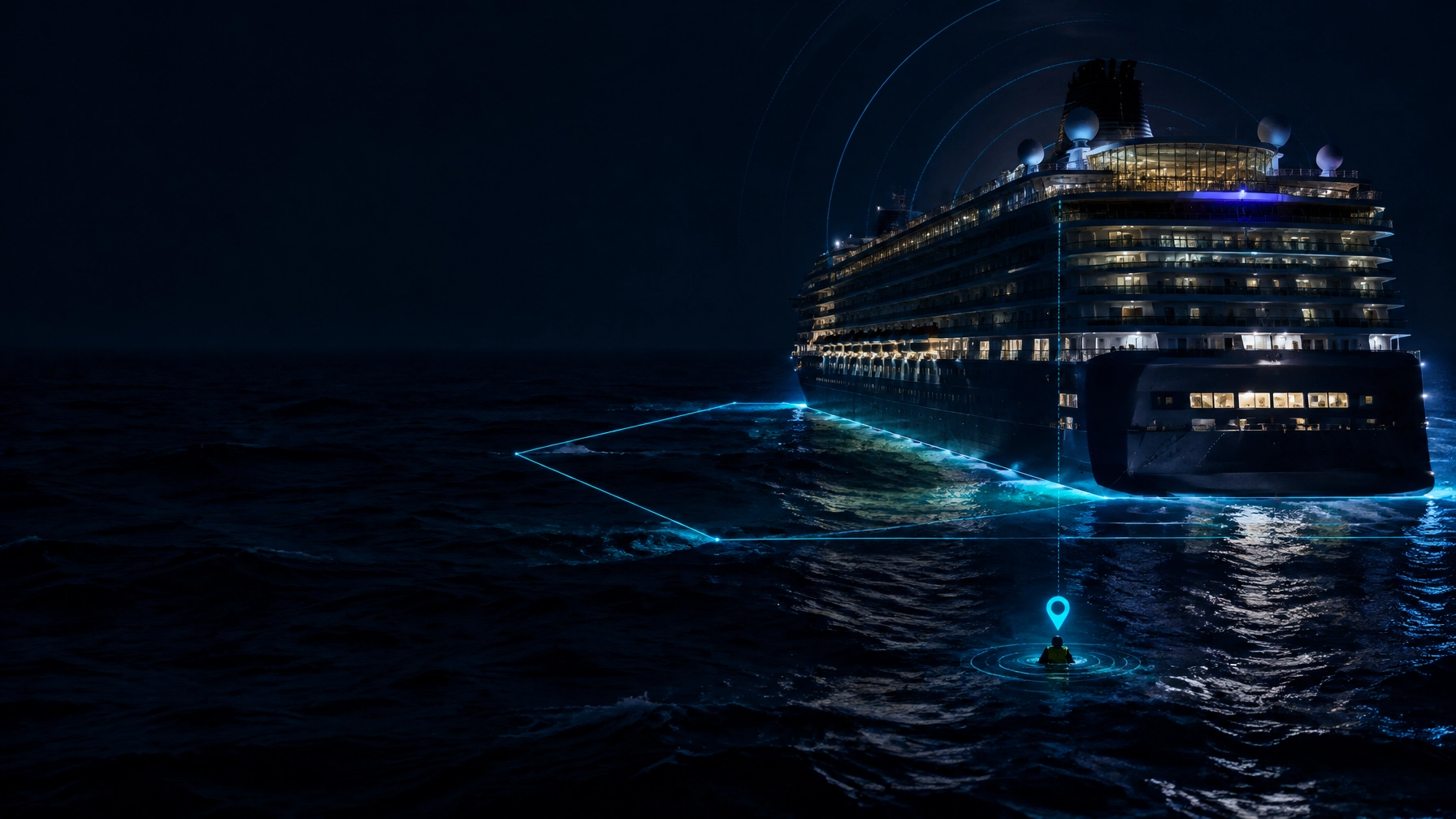
Fleet evaluation scope
A man-overboard (MOB) system is not a single sensor purchase. Fleet selection involves detection coverage, event verification, position data, bridge workflow, response execution, operating conditions, and lifecycle support.
For context on system categories, see Man Overboard System vs. Man Overboard Wristband: Which Is Better for Your Crew?. This guide focuses on procurement criteria and vendor evaluation rather than repeating that comparison.
1. Compare detection architectures
| Architecture | Primary detection input | Evaluation focus | Typical limitation |
|---|---|---|---|
| Ship-perimeter sensors | Cameras, thermal cameras, LiDAR, radar | Coverage, visibility, installation positions, event verification | Occlusion, environmental conditions, vessel geometry |
| Wearer-worn sensors | Accelerometer, barometer, water-immersion sensor, GPS | Wear compliance, detection latency, sensor fusion, battery life | Depends on device being worn and configured |
| Hybrid layered deployment | Perimeter sensors plus wearer-worn devices | Cross-validation, shared alerts, fallback behavior | Greater integration and maintenance requirements |
Perimeter systems monitor areas around the vessel. Vendor proposals should identify blind spots by deck, side, camera angle, operating state, and environmental condition. Ask whether the system identifies an event automatically, captures imagery for later review, or both.
Wearer-worn systems detect an event from movement and environmental data associated with the person. Their coverage depends on device issue, charging, fit, wear compliance, and connectivity. Require procedures for missing, damaged, uncharged, or unassigned devices.
Hybrid deployments can provide complementary inputs. They also require clear rules for duplicate alerts, sensor disagreement, communications failure, and event closure. Avoid treating additional sensors as added reliability unless the vendor explains how their data is combined and tested.

2. Evaluate fusion, false alarms, and speed
Single-sensor triggers
A single threshold can be easy to explain and test. It can also be sensitive to isolated events, such as sudden motion or pressure changes. Ask which conditions produce an alert and whether thresholds can be configured by device, vessel, or operating profile.
Multi-sensor fusion
Fusion evaluates more than one signal before generating an event. For a wearable device, relevant inputs may include acceleration, barometric change, and water immersion. CruiseShipWristband’s Location Provider app uses these signals for sub-2-second fall detection. Require a vendor demonstration that distinguishes sensor sampling, event classification, alert transmission, and display time; these are separate latency measurements.
Do not compare a vendor’s “detection time” with another vendor’s “bridge notification time” as if they describe the same stage. Request timestamped results for:
- Fall or boundary event to detection decision
- Detection decision to alert transmission
- Alert transmission to bridge display and audible indication
- Event detection to location update and verification data
Require false-alarm results from realistic operating trials, including the denominator: alerts per device-day, per voyage, or per defined test period. Ask for event categories, rejected-alert reasons, and any changes made to reduce false alarms. An advertised low rate without a stated test duration or operating conditions is not an acceptance metric.

3. Verify location and bridge workflow
An alert without a usable location may leave responders searching a broad area. Compare continuous GPS positioning with a system that reports only an approximate fall zone. Request measured location performance, update frequency, coordinate format, signal-loss behavior, and uncertainty range under vessel-specific conditions.
Map the alert workflow from event to bridge:
- Detection timestamp and event identifier
- GPS position and subsequent position updates
- Audible and visual bridge alert
- Live camera or sensor data where available
- Acknowledgement, escalation, and event closure states
- Event log, export, and integration with existing shipboard systems
Confirm network dependencies and failure modes. Ask what appears at the bridge if GPS, shipboard connectivity, a sensor, or the control interface becomes unavailable. Confirm that alarm states, timestamps, and event records remain understandable during degraded operation.
4. Compare alert-only and response-capable systems
An MOB system may detect and report an event without carrying out a physical response. Procurement teams should document who acts after the alert, which equipment must be launched, expected response sequence, and manual procedures.
CruiseShipWristband’s two-app system links a Location Provider app on the wristband with a Drone Controller app. It is designed to launch DJI drones autonomously to deliver inflatable life vests at reported GPS coordinates, with zero human intervention required for the automated sequence and manual override available. Evaluate any autonomous response through vessel-specific demonstrations, operating limits, launch and recovery procedures, maintenance requirements, and fallback plans. Do not assume that “autonomous” removes the need for crew training or oversight.

5. Check night performance, battery, and wear compliance
Request separate day, low-light, and night test results. For camera-based systems, specify visibility and verification performance in the conditions relevant to the fleet. Thermal imaging can support night operations; confirm whether it is included, optional, or dependent on separate hardware.
For wearable systems, compare operating time in low-power mode, recharge and replacement process, low-battery alerts, and behavior after battery depletion. Validate runtime against actual crew schedules, device assignment practices, charging access, and turnaround time. A nominal all-day battery claim should be backed by a stated test profile.
Wear compliance is an operational control, not a device specification. Include issue and return records, daily status checks, charging accountability, replacement stock, and drills for missed or incorrect wear.
6. Regulatory and standards review
There is no universal IMO or SOLAS mandate requiring every vessel to install an automated MOB detection system. For covered U.S. cruise vessels, the Cruise Vessel Security and Safety Act of 2010 includes a provision for technology capable of capturing images of passengers or detecting passengers who have fallen overboard, to the extent that such technology is available. Confirm applicability with qualified regulatory counsel and the vessel’s flag and operating jurisdictions.
ISO 21195:2020 provides a voluntary technical benchmark for shipboard systems for detection of persons going overboard. It is not itself an IMO or SOLAS installation mandate. Request the vendor’s compliance matrix, test scope, test conditions, false-alarm data, detection results, and independent assessment details. A general “ISO compliant” statement is not a substitute for evidence showing what was tested.
For an additional technical discussion of sensor approaches, see Wristband Sensors vs. Deck Cameras: Which Man Overboard Detection Actually Works.
7. Procurement criteria by tier
Tier 1, Required for shortlist
- Defined detection architecture and coverage map
- Detection and alert latency reported as separate measurements
- Documented false-alarm test method and results
- Position format, update frequency, and known limitations
- Bridge alert workflow and event logging
- Battery, power, and communications failure behavior
- Relevant regulatory applicability and standards evidence
Tier 2, Required before pilot
- Day, night, and low-light test plan
- Vessel-specific installation and integration plan
- Device wear, charging, and replacement procedures
- Drill schedule, test-event protocol, and pass criteria
- Cybersecurity, access control, retention, and export controls
- Maintenance, software support, training, warranty, and spare-parts terms
Tier 3: Differentiators
- Continuous GPS updates rather than approximate event location
- Multi-sensor fusion with documented alert logic
- Live camera feed or thermal imaging options
- Autonomous response capability with manual override
- Fleet-level status reporting and consistent event records across vessel classes
Vendor comparison checklist
| Procurement question | Evidence to request |
|---|---|
| What detects an MOB event? | Sensor list, architecture diagram, detection logic |
| How quickly is an event detected and displayed? | Timestamped latency results for each workflow stage |
| How are false alarms controlled? | Trial duration, alert rate, rejection logic, event logs |
| How precise and current is the location? | Position-update interval, accuracy data, signal-loss behavior |
| What reaches the bridge? | Alert demonstration, imagery or telemetry, integration map |
| What happens after detection? | Written workflow, manual procedure, autonomous-response limits |
| How does the system perform at night? | Night test results; thermal capability and scope |
| How is operational readiness maintained? | Battery profile, wear compliance process, drills, maintenance plan |
| What supports compliance claims? | ISO 21195 evidence and applicable jurisdictional review |
| What is the fleet lifecycle cost? | Installation, integration, recurring support, spares, upgrades |
Pilot shortlisted systems on representative vessel classes and operating routes. Record detection results, false alarms, alert latency, location behavior, and system availability by condition. Convert successful pilot thresholds into fleet acceptance criteria and contract deliverables.
Request a demonstration
CruiseShipWristband provides the two-app autonomous man-overboard rescue system: sub-2-second multi-sensor fall detection on the wristband, continuous GPS positioning, autonomous DJI drone launch with inflatable life vest delivery at exact coordinates, live camera feed to the bridge, day and night operation with thermal imaging options, and all-day battery life in low-power mode.
Operations and safety teams can request a system demonstration covering detection latency, false-alarm controls, bridge integration, and the autonomous response sequence against fleet-specific operating profiles. Request a demo.
Leave a Reply