The first minute after a person enters the water is a sequence of detection, location, alerting, flotation, and vessel-response tasks. The exact order and timing depend on whether the fall is witnessed, the vessel’s procedures, available equipment, sea conditions, and distance from the casualty.
A timeline is useful for reviewing the response chain, but it is not a universal regulatory countdown. The International Maritime Organization (IMO) calls for ship-specific recovery plans informed by risk assessment, equipment, vessel characteristics, and anticipated conditions. IMO guidance on recovery plans and procedures.
00:00–00:02 | Detect the event
In a witnessed fall, a person nearby may be the first detection source. The witness should raise the alarm, point to the casualty, and maintain visual contact if safe to do so. That process must not be delayed while someone attempts to find or activate equipment.
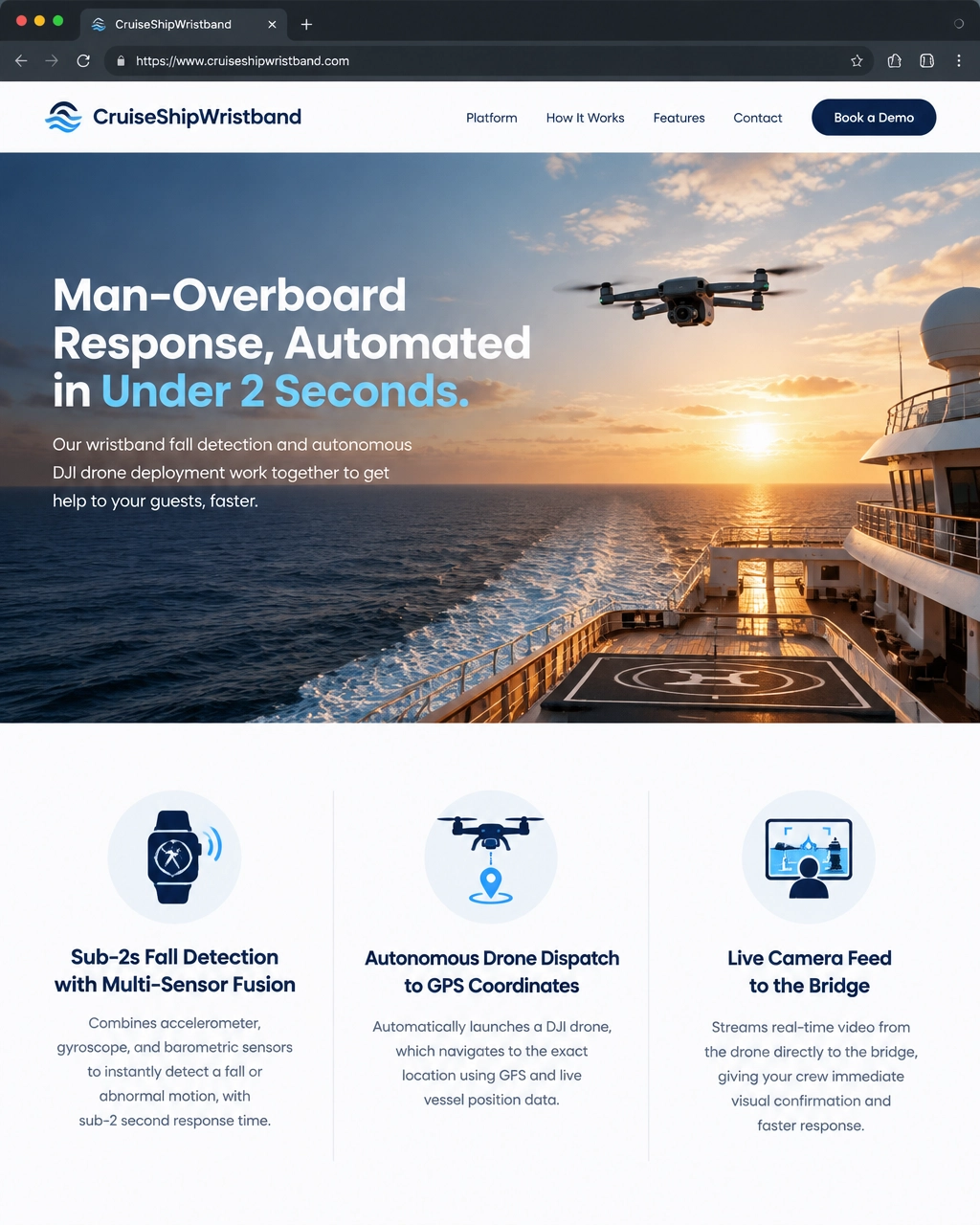
For a person wearing a man overboard wristband, detection can also begin automatically. CruiseShipWristband’s Location Provider app combines accelerometer, barometric, and water-immersion inputs to identify a fall event in under two seconds. Multi-sensor fusion is designed to reduce false positives from isolated movement or water-contact signals.
This timing describes event detection, not completion of rescue. Ship handling, drone travel, flotation delivery, and recovery follow as separate operational steps.
00:02–00:10 | Send the alert and establish location
Once the event is detected, the system needs to communicate useful information: that an overboard event has occurred and where the person is.
The Location Provider broadcasts GPS position at one-second intervals. The paired Drone Controller receives the alert and location data. This changes the starting point for the response: rather than relying only on a witness’s description or an estimated point of entry, the response team has a live position stream from the equipped person.
The alert does not replace the ship’s emergency procedures. The bridge team still needs to confirm the alert within its established workflow, communicate the event, and coordinate vessel response. A dedicated spotter should continue to track the person visually where possible.

00:10–00:20 | Begin the response in parallel
In a manual response, this phase commonly includes alerting the bridge, marking the position on available navigation equipment, assigning a lookout, and preparing flotation. These tasks can overlap; they should not be interpreted as a fixed sequence that applies to every vessel.
Transport Canada’s person-overboard procedure directs the witness to shout and point, the spotter to maintain sight, and the crew to throw available buoyant objects. It also assigns the master responsibility for a safe return to the person.
In CruiseShipWristband’s autonomous pipeline, the Drone Controller receives the alert and can initiate a pre-programmed DJI drone launch without waiting for a crew member to dispatch the aircraft. The bridge receives system status and retains manual override. Autonomy accelerates the detection-to-flotation process; it does not transfer command responsibility from the vessel’s master.
00:20–00:40 | Deliver flotation while the bridge maintains oversight
Flotation is an immediate priority because it can support buoyancy while the vessel’s recovery response is organized. A drone-delivered inflatable life vest is a distinct function from detection-only alarms or camera-only monitoring: the system is designed to connect an alert to a physical flotation delivery.
The drone uses the transmitted coordinates to navigate toward the person. GPS updates continue, and a live camera feed gives the bridge an additional view of the response. Thermal-imaging options support operations in low-light conditions, subject to the selected equipment and operating environment.
Actual flight and delivery times vary. Range, wind, sea state, launch readiness, equipment configuration, and operating restrictions all affect performance. The first minute should not be treated as a guaranteed vest-delivery deadline.

00:40–01:00 | Maintain tracking and prepare recovery
At this point, the response remains active. The bridge and crew need to maintain a shared view of the casualty’s position, the vessel’s movement, and any flotation or drone status. The lookout continues visual tracking when conditions allow. The recovery party prepares according to the vessel’s plan, with attention to crew safety and the risk of approaching the casualty with the vessel.
A drone-delivered vest does not recover a person aboard. It provides flotation while the vessel continues its response. Recovery procedures must address the vessel’s maneuverability, freeboard, equipment, available crew, weather, waves, and propeller hazards. IMO guidance recommends planning for recovery in a horizontal or near-horizontal position where practicable and conducting recovery clear of the ship’s propellers.
The first 60 seconds therefore contain two parallel tracks:
- Casualty support: detection, position updates, flotation delivery, visual tracking.
- Vessel response: bridge alert, lookout assignment, safe maneuvering, recovery preparation.
Why the detection model matters
An unwitnessed fall introduces a major delay risk: the response may not begin until someone notices the person is missing or a monitoring system identifies the event. CruiseShipWristband’s approach is designed to shorten that detection gap for people wearing the device, then carry the alert through to flotation delivery.
The two-app system divides those functions:
Location Provider, wristband-side
- Accelerometer, barometric, and water-immersion sensing
- Fall-event detection in under two seconds
- GPS broadcasts at one-second intervals
- Low-power mode for all-day operation
Drone Controller, ship-side
- MOB alert and position reception
- Autonomous DJI drone launch
- GPS-directed flight and inflatable vest delivery
- Live camera feed and status for the bridge
- Manual override for the security team
The distinction is operational: a detection-only mob system may notify personnel that an event occurred, while an integrated detection-to-flotation system also initiates a response and delivers buoyancy. This does not eliminate the need for lookouts, bridge procedures, drills, or recovery equipment. It reduces dependence on a human noticing the fall and manually starting every step before flotation can be sent.
For a comparison of detection approaches, see Wristband Sensors vs. Deck Cameras and Man Overboard System vs. Man Overboard Wristband.
First-minute review checklist for maritime operations
A practical review of cruise ship safety and maritime safety technology should test the full chain, not only the alarm:
- Detection: What triggers the alert, and how quickly?
- Position: Does the bridge receive coordinates that continue to update?
- Alerting: Who receives the event, and how is acknowledgement handled?
- Flotation: What delivers buoyancy before vessel recovery?
- Oversight: Can the bridge track the event and intervene when required?
- Operating limits: Which weather, connectivity, battery, or equipment conditions affect availability?
- Recovery: Does the ship-specific plan account for safe maneuvering, crew roles, and recovery equipment?
CruiseShipWristband connects wristband-based detection to GPS tracking, autonomous drone launch, inflatable vest delivery, and bridge visibility. Its design target is a continuous response pipeline, not an alert that leaves the next operational step entirely manual. System deployment should be validated against vessel procedures, operational constraints, and the ship’s approved recovery plan.
Request a system demonstration
Operations and safety teams can see the full pipeline, from wristband detection through autonomous drone launch to vest delivery and bridge visibility, in a system demonstration. The session covers detection latency, false-positive handling, GPS tracking behavior, integration with existing bridge procedures, and day/night operating limits against your fleet’s operating profile.
Explore the CruiseShipWristband system · Install Location Provider · Install Drone Controller
Leave a Reply